(Chinese) Garden City: A Complementary Model for Asian Urbanism
- Studio Anchor
- Jun 5, 2022
- 9 min read

Competition
9th Advanced Architecture Contest: Design for Biocities
Organizer
Institute for Advanced Architecture of Catalonia
Type
Conceptual
Site Location
Bao'an & Guangming District, Shenzhen
Collaborator
Linggar Surya Mahendra
Issue
Historically, humans have settled in regions where [1] climate is moderate, [2] resources are plentiful, and [3] overall conditions support agriculture. More than half of the world's population lives in the Indian subcontinent and Asia in general. Cities as the greatest manifestation of human habitat, tend to be built in areas with plenty of natural water resources. They are mostly built along with the coastal areas or riverbanks before further expanding inland. As humans progress, they began to increase in population size and thus dramatically increase the amount of land they occupy.
Research has shown that huge human concentrations have obliterated many natural habitats and have pushed some species close to extinction. We've cleared forests, diverted rivers, and paved over fields in building our homes. We've moved mountains in order to obtain what lies beneath them, and we have found ways to leverage even the most extreme environments for our gain. We’ve cultivated vast amounts of available land for croplands and pastureland in order to feed ourselves. No place seems to be immune to the constant creep of human progress.
Take a look at the works of Annibale Siconolfi, an Italian artist showcasing the extreme impression of the dystopian future caused by the Anthropocene. The highly disruptive, out-of-this-world illustrations of how our cities might look in perhaps the very far future show how massive the footprint of built environments or ‘grey’ structures have dominated the surface of the Earth. These kinds of imagery might look appealing to those who are fond of the work of visual arts as those with sci-fi in movies or video games telling a story about a hyper-real environment where everything seems sophisticated through the futuristic technologies we might have. At the same time, we can observe that natural resources are already dramatically depleted, and the remaining natural landscape illustrated might be either necessarily artificialized or perhaps even worse, a gimmick. If it really comes down to it, not even the highly protected ecological environments will remain if we are not able to manage our production and consumption of land.
Dystopian Urban Future Illustrations by Annibale Siconolfi.
Based on sustainable movement projects discussed globally, perhaps it can be narrowed down that there are a few most problematic aspects causing this unbalanced situation between the man-made and nature. First and foremost, is the transportation system. Our dependency on private cars and road-based logistics forces us to build vast stretches of road networks that causes nearby ecosystem vulnerable to contamination. Second, our current building technology and mining-dependent economy can only make the most of building cities and their supporting infrastructures with a high carbon footprint and non-permeable materials such as concrete and steel. Last but not least, our inefficiency in managing our land use effectively has caused massive urban sprawls throughout the globe. All of these issues have led to situations where the more humans expand their presence, the more natural ecosystems are in peril.
Hence the widely discussed environmental issues and the solutions provided by experts, the urgency for this project is aimed towards developing the right attitude, specifically how the Asian landscape should be prepared as a fairly-maintained ecosystem for humans and non-humans hence the anthropocentric domination. The greatest problem of sustainability or ecologically-friendly urbanism discourses anywhere is not that it is lacking in design solutions, it is primarily about convincing people why it makes sense in the first place.
Background & Context
The significance of Urban Design & Planning discourses came to light with the predictions about the potential increase of the human population many years in the future. An increasing population means that there will be an increasing demand for cities. Particularly looking at Shenzhen, which is predicted to house 15,181,000 people in 2035, an additional 2.354.000 from the current population. Perhaps it doesn't seem that much in percentage, but surely you'll change your mind once you see the current footprint of built-up areas.

Annual growth of Shenzhen's Population. (via macrotrends.net)
Urbanism discourse becomes a great necessity when looking at Asia since it is home to more than half of the world’s population compared with other continents on Earth with China on top of the chart. The fact that most Asian landscapes are suitable for agricultural land-uses makes it even more important to carefully plan and manage the allocation of lands. For instance, in China, from 1978 to 2008 the urbanization rate was rising from 16-18% to 45%. In 2015, the population rose even more to 56%. It is either the 357 million farmers moved to cities or transformed their villages into towns, furthermore, cities. It is shown by the increase in the number of cities from 193 to 655 cities in China.
Based on a book written by Professor Shiqiao Li, Understanding the Chinese City, the most obvious characteristic of Chinese Cities lies in the term City of Maximum Quantities, with Hong Kong at its extremities. The term ‘quantity’ become a very important cultural aspect in China rooted in the Chinese numerical schemes which then paved the foundations of the way of life in Chinese cities. Compared to the Western modernism jargon, ‘less is more’, the most important feature of Chinese cities in relation to quantities is that ‘more is more’ and ‘less is less’. Li described this as the discourse of Abundance in his book, which is important to life promotion and preservation in the Chinese cultural context. As opposed to the Western pursuits of beauty and authenticity in Architecture, the Chinese cultural context - especially the government - is more attracted to developing economic stability throughout China - rather than pursuing Western aesthetics of avant-garde architectural artifacts. This was achieved through the vastly built Transit-Oriented Development (TOD) project which usually consists of uniform or typical high-rise mixed-use developments throughout the land supported by rail networks. We can also see the fact that the building construction process in China is relatively fast in order to build as many as possible. Of course, this mindset also allows some problems related to building life-span in China which usually are shorter compared to the Western or other developed countries. The key to building planning and construction in China then lies heavily in the standardization established by the governments in order to provide a safe and secure living environment.
The rapid urban expansion in Shenzhen began when the notable Chinese reformer, Deng Xiaoping decided to establish it as one of the Special Economic Zones (SEZ) in China between 1978 and 1984. Previously a fishing village located on the east bank of the Pearl River Delta, Shenzhen has transformed into a coastal megacity after 40 years of rapid development. The key factor of Shenzhen's urbanization is due to the promising economic potential brought by industrialization.

Shenzhen’s Urban Expansion Based on Land-Use/Land-Cover Classification. (Zhou H., et al)
Studies have shown that Shenzhen’s fast development and progress have a serious environmental impact because of the rapid urbanization which resulted in losses of farmland, forest, wetland, and bodies of water since 2000. In 1988, urban areas in Shenzhen were mainly developed only around the Shenzhen bay while the Western coast, Mideast, and Eastern part was still widely a series of bare and cultivated lands. As the economic activities progress, we can see that eventually in 2015 most of Shenzhen’s build-able lands are defined as built-up areas. This was no other due to the rapid urban sprawl which has proven to be the cause of weakened or destroyed ecological services of the existing river systems. The degradation of natural water resources is dire since water is essential to every form of life on Earth. Systematically, the impacts are varying from the risk of urban flooding, clean-water scarcity, urban pollution, and even loss of biodiversity.
This project tries to take on 1980s Shenzhen, particularly the Western coastal areas to provide physical context before the rapid urban sprawl occurs in order to be able to identify similar characteristics of other Asian cities which might happen to have the same fate. The general idea would be to consider the extreme conditions where the population would really increase dramatically in the future and thus take precautions immediately. In any way, the (urban) future will be something we invent, not helplessly predict as Michael Batty promoted.

Shenzhen Land Use in 1988. (Zhou H., et al)
Of course, this argument is very debatable considering that many efforts are already pointed toward how the urban planning and real estate development process can avoid such conditions. The fact Because the presence of mankind is inevitably disruptive in most situations, it is more than ever important to imagine even the environmentally sensitive areas to be envisioned as a limited urban development. The reality is that the capitalist economy makes it seem even more inevitable. Thus it should not hurt to think of a precaution if it really comes down to reality.
Proposition
The goal is not to transform the already established megacity, but to identify the conditions before the dramatic expansion, and how to redirect it towards a more balanced footprints proportions between urban and nature, especially for other emerging cities throughout Asia which might have the same fate for having relied on the traditional way of thinking and planning. The following illustration is a manipulated situation of Shenzhen’s urban footprint if we were able to control the urban expansion efficiently and more importantly, as early as possible.
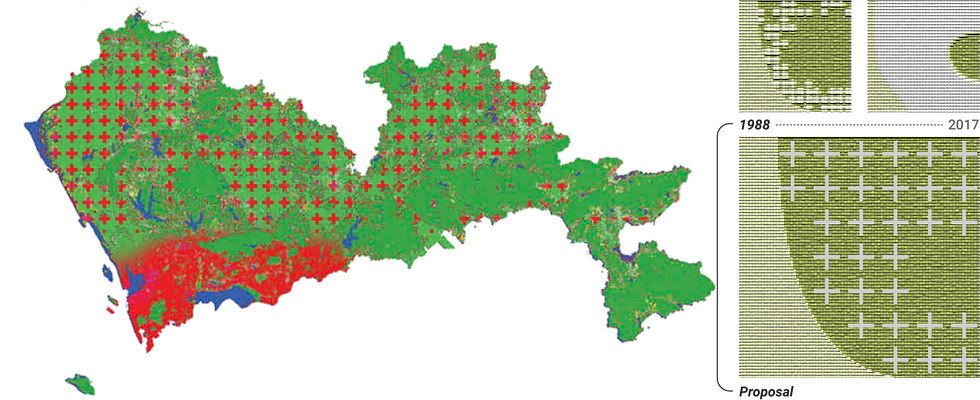
A conceptual illustration of what Shenzhen’s urban footprint might look like if we do things differently.
The idea of this project is simply to test the idea of Intensive Care by discovering the limits or challenges if it is actually implemented on an urban scale while also taking into account the prominent environmental issues and sustainable agendas. The urban scale intensive care is intended as an act of removing the jianghu (江湖) or the attitude of carelessness toward the 'absolute outside' - spaces without care in the Chinese cultural context.


A Grammer for the City. (Office KGDVS x DOGMA)
Working on a pattern-based framework, this project tries to explore the potential of the typical cruciform building masses from the work “A Grammer for the City” by Office KGDVS and DOGMA as a case study to simulate density.
Results

Masterplan for (Chinese) Garden City (left); Patterns for the neighborhood anchors/downtowns (right).

Building block module (top left); Wood construction scheme (top right); The great wall of intensive care (bottom).

Sample Area Key Plan (left); Patterns for Blue-Green Infrastructures (right).
Evaluation & Further Research
It is quite tricky when - an Indonesian scholar, Muhammad Unies Ananda Raja points out that since the existence of humans on earth, there has never been a balance between human creations and natural conditions which they exploit as the only way for this species to survive.
By being able to imagine the limits of how human civilization could disrupt the natural ecosystems, the least that we can do for future civilization is to manage our desires to exploit lands inefficiently. To be neglecting the importance of maintaining the existing natural ecosystems is the same as neglecting the fact that humans need to be ‘fed’ while the resources to do so are limited. The epoch of the Anthropocene should bring the discourse towards adapting and managing the potential human disruptions instead of looking to reverse the situation towards an environmental equilibrium that never existed since humans exist.
On the surface, this proposed Biocity project is about environmentally friendly urban design & planning. But rather than focusing on the elements that make a city ecologically friendly, instead, we are focusing on how might we convince people that making environmentally-friendly cities are important in the first place. Hence urbanization can relieve the pressure on natural landscapes while providing an opportunity for greater energy efficiency, it also poses some threats in form of generating air and water pollutants. Perhaps this issue can be avoided if we are careful enough to formulate a responsible system for living.
This work should be seen as a critical standpoint on how we should responsibly take care of and manage the built and natural environment, not necessarily having to become the right-wing environmentalists, tree-huggers aimed to ‘save the planet’. Being responsible and critical doesn’t mean we have to be a hero.
Additional Notes
About the Project:
To rethink how we should administer the territory.
To rethink how we should manage land (real estate).
To rethink how we should run the relevant business model.
Anthropocene with the preserved ecosystem.
To identify similar situations in other developing Asian cities which might be subject to rapid economic growth.
To rethink population boom with mankind's lifespan. To what point should we increase, decrease, or even stop the population growth?
For future Design Process:
How to learn from precedents effectively. (Pattern-based)
The extent to be able to document urban design ideas comprehensively.
To learn how various roles (re: stakeholders) exist and how each other plays their parts in a real project.
Bibliography
Li, S., 2014. Understanding the Chinese City. Los Angeles (Calif.): SAGE.
Carrol, A. and Wilber, H., 2022. Living in the Age of Humans. [online] ArcGIS StoryMaps. Available at: <https://storymaps.arcgis.com/collections/cf8b6867ad954a6e9ed400ca9e9206ea?item=1>
Batty, M. (2018). Inventing Future Cities. MIT Press.
Dou, P., & Chen, Y. (2017). Dynamic Monitoring of Land-Use/Land-Cover Change and Urban Expansion in Shenzhen Using Landsat Imagery from 1988 to 2015. International Journal Of Remote Sensing, 38(19), 5388-5407. https://doi.org/10.1080/01431161.2017.1339926
Bosschaert, T., Woning, J., & Verhaart, J. (2022). System Transition Wood Construction NL: Establishing a Sustainable Timber Industry in the Netherlands. Except.eco. Retrieved 22 April 2022, from https://except.eco/projects/boosting-ewp/.
Roberts, D. (2020). The Hottest New Thing in Sustainable Building is, uh, Wood: The Many, Many Benefits of Using Wood in Place of Concrete and Steel.. Vox. Retrieved 22 April 2022, from https://www.vox.com/energy-and-environment/2020/1/15/21058051/climate-change-building-materials-mass-timber-cross-laminated-clt.
Zhou, H., Shi, P., Wang, J., Yu, D., & Gao, L. (2011). Rapid Urbanization and Implications for River Ecological Services Restoration: Case Study in Shenzhen, China. Journal Of Urban Planning And Development, 137(2), 121-132. https://doi.org/10.1061/(asce)up.1943-5444.0000051
Jenkins, M. (2020). Shenzhen Explores the Benefits of Designing with Nature. Lincoln Institute of Land Policy. Retrieved 22 April 2022, from https://www.lincolninst.edu/publications/articles/sponge-city-shenzhen-explores-benefits-designing-with-nature.
Plowright, Philip D. Revealing Architectural Design: Methods, Frameworks, & Tools. Routledge, 2014.
Changing the Future of Mobility with Passenger Drones - FutureBridge. FutureBridge. (2020). Retrieved 22 April 2022, from https://www.futurebridge.com/blog/changing-the-future-of-mobility-with-passenger-drones/#:~:text=FutureBridge%20estimates%20that%20the%20commercialization,registering%20a%20CAGR%20of%2045%25.
Fu, H., Liu, Y., Chen, Y., Hu, J., Zhang, Y., & Hu, Q. (2018). Study on the Construction Mode of Water Ecological Civilization in Coastal Cities——Taking Shenzhen as an Example. MATEC Web Of Conferences, 246, 02034. https://doi.org/10.1051/matecconf/201824602034
Yue, D., Liang, Z., & Guang, H. (2022). VSEFI Community - Non-Architecture. Non Architecture. Retrieved 22 April 2022, from https://www.nonarchitecture.eu/2022/03/14/vsefi-community/#lightbox[group-329011]/4/.
More Info about the Competition:
Comments